

Monastery of the Presentation of the Holy Mother of God in Sremski Karlovci





First mentions and early history
The exact time of construction of the Upper Church in Sremski Karlovci, dedicated to the Presentation of the Blessed Virgin Mary, is not known, although there are serious hints that it existed even in the pre-Ottoman times. Recent archaeological research has proven that the temple most likely originates from the first decades of the 16th century. Underneath the current building, the remains of an older church were found, with a base in the form of an inscribed cross, which points to the 15th century. Its original window openings and floor, as well as the way the first wall was erected, testify quite reliably that it was really built during the time of the holy-born Branković dynasty. The first indirect mention of the temple dates back to 1559, from the inscription at the bottom of the Gospel, which was chained with silver by the “sinful Pava the goldsmith”. It states that the future Cathedral of the Karlovac Metropolis, dedicated to Saint Nicholas, was called the “Lower Church”, which implies that there must have been an “Upper” one somewhere.
Archpriest Radoslav Grujić thought for a long time that this place was home to a female monastic family, in which “Despotess Jelena”, the widow of Saint Stevan Štiljanović, spent the last years of her life as a humble nun. It was also believed that the Holy Mother Angelina lived in the Karlovci monastery during the execution of the paintings on her Krušedol endowment dedicated to the Meeting of the Lord. Based on an inscription in a menology, it can be concluded that there really was a monastery here in 1561. It mentions Hegumen Joakim and an unnamed “humble monk”, while the travel writer Prandstadter also mentions a female monastic family, in addition to the parish churches in Karlovci, in 1608.
However, most historians believe that the Upper Temple was established as a monastery place of worship shortly after the signing of the Treaty of Karlovci in 1699, and it was first unequivocally mentioned only in 1707, when the local monk Makarije obtained an old manuscript book. Only a year later, the same hieromonk “with much effort” collected five more handwritten menologies, which leads to the conclusion that the necessary liturgical books were quickly collected for the newly reconstructed of the place of worship. Another local menology was restored by the priest Živan Hajdarević in 1711 and in the following year Hieromonk Makarije bought the prologue. Deacon Mihailo wrote a menology for the Monastery of the Presentation in Sremski Karlovci in 1713, when Melentije (Jovanović), later hieromonk of the Bešenovo Monastery, was ordained as a hierodeacon in this place.
Parish church in Sremski Karlovci
In 1716, the temple was damaged during the retreat of the Turks and was consecrated again by Metropolitan Vikentije (Popović Hadžilavić) on October 12, 1718. In the same year, Nikolaj (Milisavljević) from Novo Hopovo received the presbyterial rank in this holy place. It is also recorded that Hieromonk Makarije, a dedicated “book lover”, who during his zeal in rebuilding the monastic library, unintentionally removed the opaque veil from the first centuries of the monastery, left this world in this monastery in 1719. Here, a brother from Grgeteg, Joanikije (Milosavljević), was ordained in 1721 as well as the Hegumen of Vrdnik, Joanikije (Maksimović), in 1729, while the historian and Archimandrite Jovan (Rajić) of Kovilj received the Holy Sacrament of Baptism in 1726. The bell tower with the crypt was added by 1731 and this stone and mudbrick building with a dome and a shingle roof was described in more detail in 1733. Dimitrije Ruvarac writes that the interior of the old monastery dormitory, located on the south side of the churchyard, consisted of two rooms, a kitchen and a basement, with a roof covered with boards, until 1810, when the decision was made to demolish this ancient edifice.
After fundamental reconstructions of this sacred complex, numerous data on monasticism and ordinations of members of various families from Fruška Gora clearly indicate that this is still a monastery place of worship. Josif (Josifović) from Beočin, 1734, Danijel (Starostovski) and Sofronije (Popović) from Šišatovac, 1745, Jeftimije (Nikolić) from Krušedol, 1751, Teodosije (Pavlović) from Jazak, 1752 and Beočin’s Hegumen Arsenije (Popović), 1753, were ordained in the Monastery of the Presentation of the Holy Mother of God. Furthermore, the Old Jazak nuns, Anastasija and Epistimija, received their monastic vows in 1744 and 1749.
The origin of the present-day temple
The temple was thoroughly renovated after 1739, immediately after the Second Migration of the Serbs, and works on the “belfry of Dimitrije” are mentioned in 1742. The construction project was most likely completed already the following year, when Jovan Živković, the parish priest, concluded a contract in Buda on the order of new bells. Around the same time, an icon of the Mother of God with Christ was added to the Church of the Presentation, made by the painted Georgije Stojanović. Finally, a plaque on the west side of the tower testifies that the Upper Church was rebuilt from the ruins by Patriarch Arsenije IV (Jovanović Šakabenta) in 1746. Thanks to him, in 1747, when a large situational plan of Karlovci was drawn up, the earliest pictorial data on the appearance of this holy place were created. In 1778, the travel writer Wilhelm von Taube testified that the interior of the ancient Upper Church is better arranged and decorated than the Cathedral, which was built only “twenty years” earlier. The description of temple from 1791, compiled by the order of Metropolitan Stefan Stratimirović, is of exceptional importance.
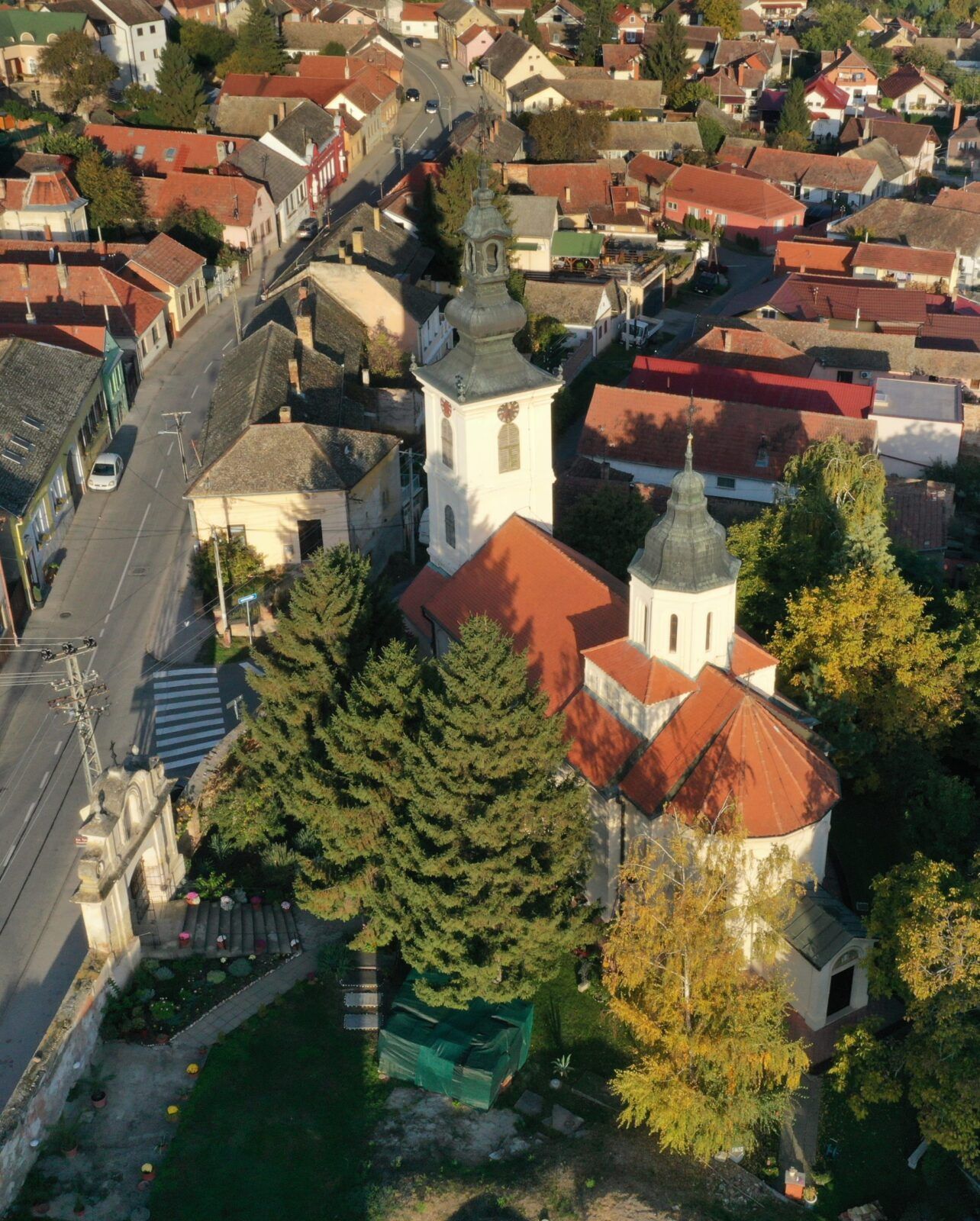
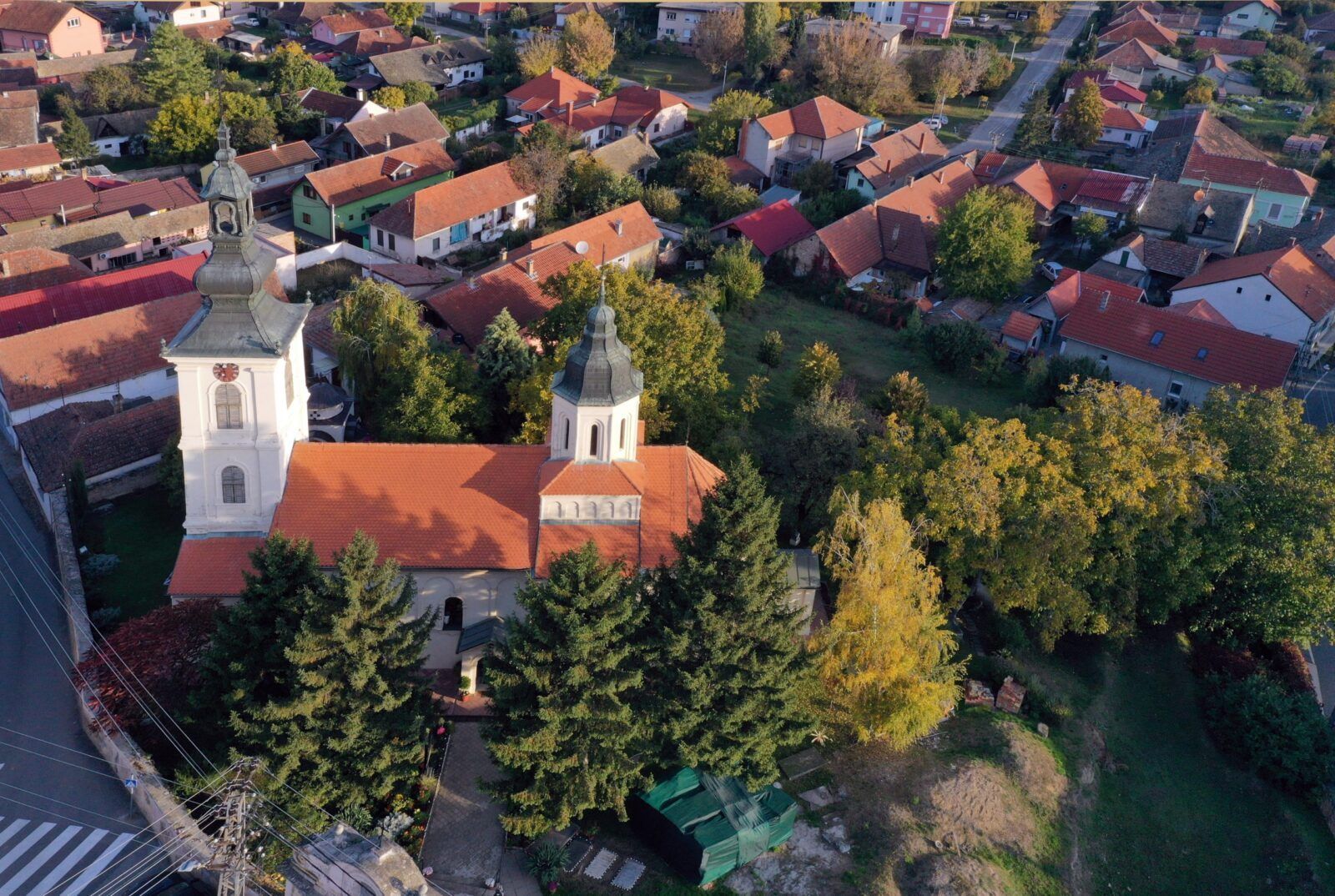
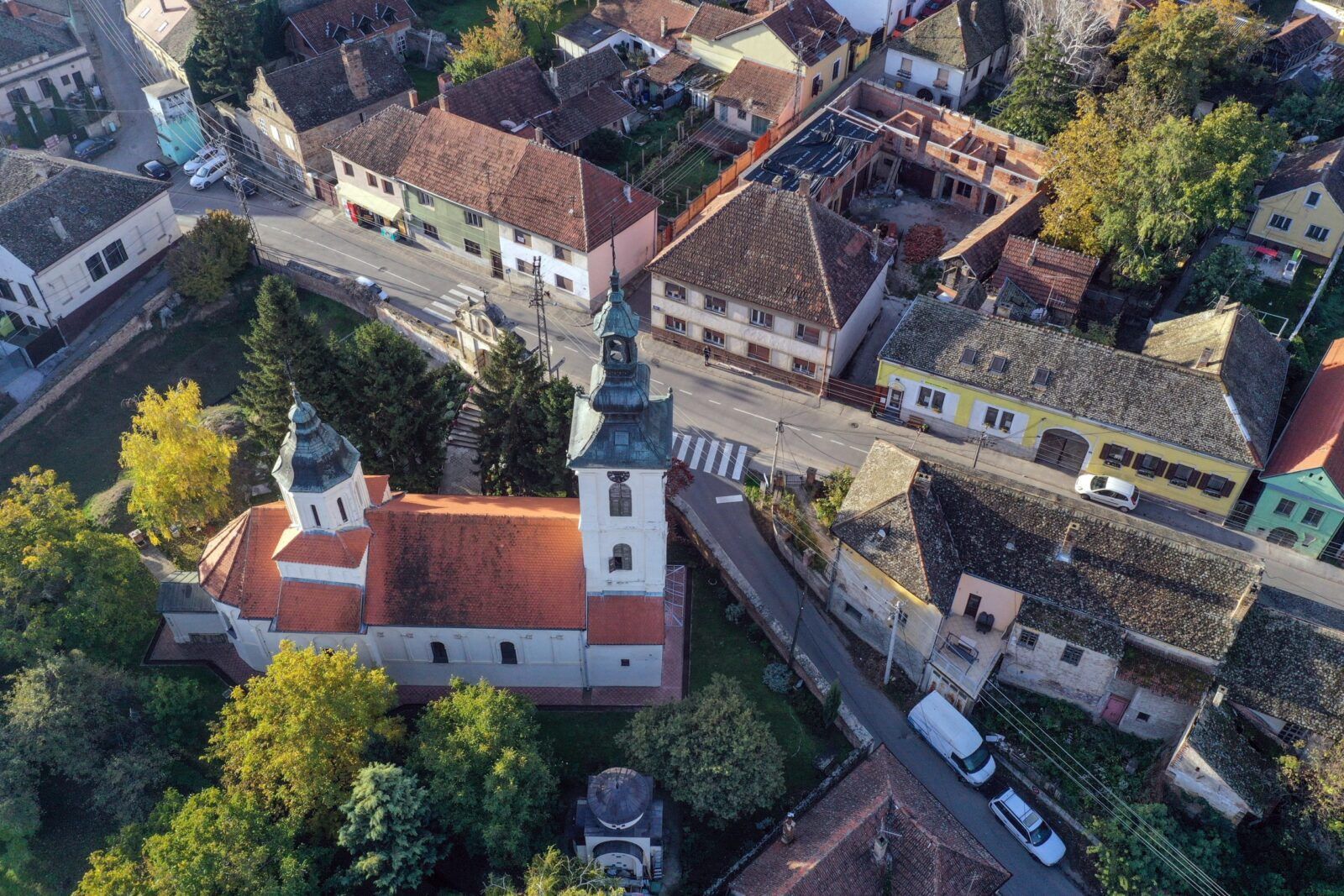
The developed iconostasis partition was painted by Dimitrije Bačević, from 1760 to 1761. From the earlier iconostasis, today only two large throne icons have been preserved, the Lord Jesus Christ and the Blessed Virgin Mary, which were executed by an unknown artist in the first half of the 18th century. Several icons for veneration were made by Teodor Kračun between 1770 and 1780, while the painting and gilding work on the interior of the temple was carried out by Georgije Bakalović in 1824 and 1825. Unfortunately, only parts of the altar have been preserved from Bakalović’s work. Major renovations were carried out after 1833 and from 1897 to 1903. Finally, the temple of the Presentation of the Holy Mother of God represents an edifice built under “the undoubted influence of traditional architecture, with a dome of circular section on the inside and octagonal on the outside, the usual square base, a series of blind arcades, a seven-sided altar apse and leaning pillars on the surfaces of the facades called baroque pilasters”.
In the mid-1980s of the 20th century, a hard cardboard was found under the inditia of the Holy Table with the inscription of Archpriest Vasilije Konstantinović, which reminds of the restoration of the temple carried out under the direction of Patriarch Georgije (Branković) in 1903. On that occasion, “the iconostasis was all cleaned and gilded. The walls, trullo and the whole church got plastered. Analogions and all tables coated. In the women’s church, two completely new windows were opened, and in the altar from the east, the old window was bricked up, and two new were opened. The old brick table was removed, and the new oak table was furnished. On the roof around the dome, the sides are covered with sheet metal. In the church, in the middle of the temple, the place of the old, half-burnt marble is covered with colorful panels. And on that occasion, the men’s door was removed from the outside and a glass one was placed inside. Under the altar, a burial tomb was built with a corridor on the outside, according to the wishes of His Holiness Patriarch Georgije. This entire work was carried out by the architect Vasa Nikolić. According to him, 8,000 crowns were spent on all this work.” The restored church was consecrated by the Buda Bishop Lukijan (Bogdanović), at the Holy Bishop’s Liturgy, which he celebrated with four priests and two court deacons and which was attended by the Patriarch Georgije (Branković) and the Vršac Bishop Gavrilo (Zmejanović). In 1910, on the Beheading of John the Baptist feast day, in the Upper Church, the liturgy served by Archpriest Konstantinović was attended by a doctor of theology, parish priest in London and Nuremberg, brother of the Saxon King Frederick Augustus, “His Royal Highness Prince Maximilian of Saxony” and the third son of the Saxon King George.
Holy relics and graves
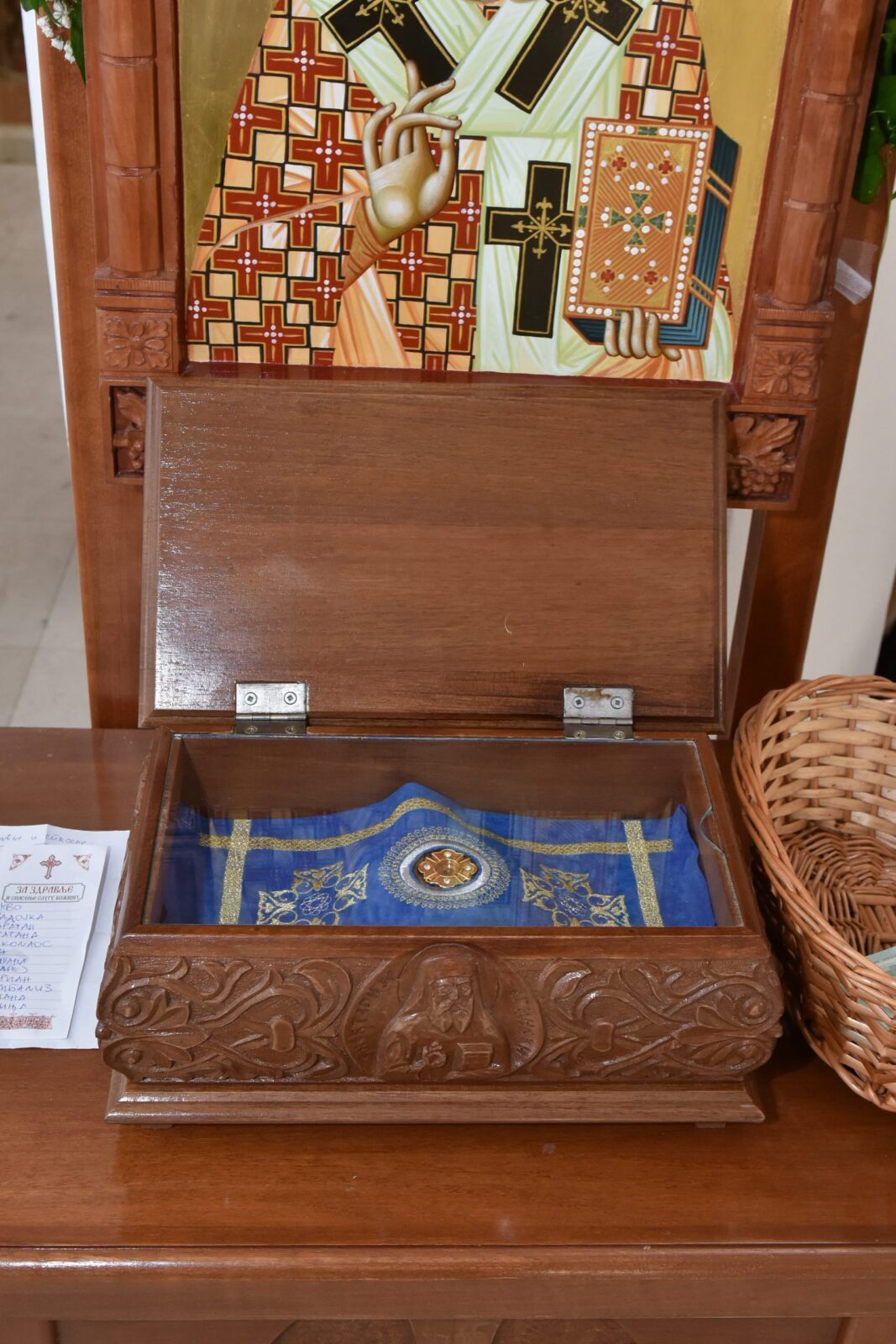
In this church, a fragment of the relics of Saint Nektarios of Aegina is preserved, while Archimandrite Gerasim of Hilanda (1761), Exarch Nikanor (Pavlović) (1730), Bishop Dositej (Nikolić) of Valjevo (1738), as well as the parents of the bishops of Timișoara, Petar and Bačka Jovan (Jovanović), who together erected a decorative marble slab in 1793, are buried in the churchyard. Nuns Evgenija and Maria from Novi Sad were buried near the Upper Church in 1756. They most likely lived their ascetic lives in the monastery cells mentioned by Ruvarac. Karlovci resident Boško Mihajlović (1731), Syncellus Pavle (Georgijević) (1752), the owner of the famous baroque house and long-term tenant of the post office, Jakov Andrejević (1772), several protopresbyters, elders of the temple, hieromonks and monks rest here and in the crypt lie Serbian patriarchs Georgije (Branković) (1907) and Lukijan (Bogdanović) (1913).
Treasury of the Monastery
This monastic family owns liturgical books from the 18th, 19th and 20th centuries and the books of sermons printed during the time of Prince Miloš Obrenović are particularly interesting. Part of its inventory, including gold-embroidered clothes, which Princess Ljubica Obrenović contributed in the fifth decade of the 19th century, is stored in the Treasury of the Museum of the Serbian Orthodox Church in Sremski Karlovci. In the aforementioned institution, the Octoechos by Božidar Vuković, printed in Venice, 1537, the Belgrade Four Gospels from 1552, the Srbljak of Rimnice from 1762, as well as the Scroll of the Russian Patriarch Nikon, published in seventeenth-century Moscow, are kept.
The great renovation and the establishment of the monastery
The overall renovation of this sanctuary has been going on since 2012 and works are currently being planned for the construction of the monastery dormitory, as well as the remodeling of the lower part of the churchyard into a suitable park. On January 14 (1), 2016, His Eminence Bishop Vasilije of Srem, declared “the Church of the Presentation of the Blessed Virgin Mary in the Upper Town of Sremski Karlovci to be the Monastery of the Presentation of the Blessed Virgin Mary”, re-establishing the ancient monastic order in this sacred building.